
1. What Is Death Stranding? The Meaning Explained
Before answering whether Death Stranding 2 is worth playing, it helps to understand what “Death Stranding” actually means — because the term is not just a title. It is the core concept around which Hideo Kojima built an entirely original mythology.
In the world of Death Stranding, a cataclysmic event called the Death Stranding has caused the boundary between the world of the living and the world of the dead to collapse. Creatures called BTs — Beached Things — are entities from the afterlife that now roam the physical world, invisible to most people and deadly to those who encounter them. When a living person is consumed by a BT, a massive explosion called a voidout occurs, capable of destroying entire city blocks.
The term “Death Stranding” comes from real-world biology — specifically whale and dolphin beachings, where sea creatures wash up on land and die, stranded out of their natural element. Kojima inverted this concept: the dead are “stranded” in the world of the living, unable to fully return to the afterlife and unable to exist peacefully alongside life. The result is a world where humanity has retreated underground into isolated cities, and surface travel — once taken for granted — has become extraordinarily dangerous.
This mythology is the foundation of both games. Everything in Death Stranding — the ghosts, the rain that ages whatever it touches, the babies used as detection equipment, the ropes and ladders left by other players — flows directly from this core concept of boundaries between worlds being broken.
2. Who Created Death Stranding? Hideo Kojima’s Story
Death Stranding was created by Hideo Kojima, one of the most distinctive auteurs in video game history. Kojima was born on August 24, 1963, in Tokyo, Japan. He joined Konami in 1986 and spent nearly three decades there, creating the Metal Gear series — which effectively invented the stealth action genre and elevated cinematic storytelling in video games to levels not seen before.
The defining event in Kojima’s career came in 2015 when he departed Konami under circumstances that were, at the time, deeply public and contentious. Konami removed his name from the Metal Gear Solid V: The Phantom Pain promotional materials before the game’s release and ultimately parted ways with him. Kojima then founded Kojima Productions as an independent studio in December 2015, headquartered in Tokyo.
Death Stranding (2019) was the studio’s first independent game — a radical departure from anything Kojima had made before, deliberately designed to challenge what a video game could be about. The concept of connection, isolation, and rebuilding broken societies was deeply personal. Death Stranding 2 continues that vision with the sequel he describes as the culmination of his creative philosophy.
| Detail | Information |
|---|---|
| Creator | Hideo Kojima |
| Born | August 24, 1963 — Tokyo, Japan |
| Previous Work | Metal Gear Solid series (1987–2015) at Konami |
| Studio Founded | Kojima Productions, December 2015 (Tokyo) |
| Death Stranding 1 | PS4/PS5, November 2019 |
| DS1 Director’s Cut | PS5/PC, September 2021 |
| Death Stranding 2 | PS5, June 2025; PC, March 19, 2026 |
| Engine | Decima Engine (licensed from Guerrilla Games) |
| Cast | Norman Reedus, Léa Seydoux, Troy Baker, Elle Fanning, Shioli Kutsuna |
Kojima’s creative philosophy — sometimes summarized as “making games that create a new genre” — is nowhere more visible than in Death Stranding. He has described the franchise as his attempt to create a “strand game”: a new genre built around connection, cooperation, and the positive social acts of building, helping, and repairing rather than shooting, destroying, and competing. This is the philosophical heart of everything both games do.
3. What Is Death Stranding 2: On the Beach About?
Death Stranding 2: On the Beach is a standalone sequel set approximately 11 months after the events of the original game. The story follows Sam Porter Bridges — played by Norman Reedus — who has moved to a remote cabin in Mexico following the events of DS1 and believes his delivery work is done. It is not.
Sam is recruited by a new organisation called DRAWBRIDGE, tasked with connecting the continent of Australia to the Chiral Network — the digital infrastructure that allows isolated communities to communicate and share resources. Australia, in DS2’s world, is a continent full of survivors who have never been connected. Sam’s companions in DRAWBRIDGE include familiar faces from DS1 alongside entirely new characters played by Troy Baker, Elle Fanning, and Shioli Kutsuna.
The story explores themes of memory, identity, what it means to leave behind versus remain connected, and the personal cost of being the person everyone depends on. Kojima has called the game his “masterpiece” — a term he applies specifically to his most recent work as the one best expressing his current creative vision.
Key Story Elements
- New continent: Australia — completely new environments including deserts, rainforests, coastal cliffs, and urbanised ruins
- Natural disasters: DS2 adds earthquakes, sandstorms, and forest fires as active threats alongside the BTs and Timefall of DS1
- DRAWBRIDGE: Sam’s new team, replacing the UCA (United Cities of America) from DS1 as the organisation driving the narrative
- New enemies: Evolved BTs, human hostile factions, and new mechanical threats requiring different strategies
- Timefall: Still present — rain that ages anything it touches, continues to be a core environmental hazard
4. When and Where Is Death Stranding 2 Available?
- PlayStation 5: Released June 2025 — available now from PlayStation Store and physical retail
- PC via Steam: March 19, 2026 — available for pre-purchase now
- PC via Epic Games Store: March 19, 2026 — available for pre-purchase now
- Xbox / Switch 2: Not announced — no confirmed date
Death Stranding 1 is also available on PC via Steam and the Epic Games Store (as Death Stranding Director’s Cut), for players who want to experience the original before DS2’s PC launch. The Director’s Cut version of DS1 includes all base game content plus bonus missions, a firing range, a race track, and quality-of-life improvements added after the original 2019 launch.
5. How Does Death Stranding 2 Actually Play? Honest Description
This is the section that matters most for players who skipped DS1 because they heard it was “a walking simulator.” Understanding the gameplay honestly — without hype or dismissal — is essential for deciding whether DS2 is for you.
The Core Loop
Death Stranding 2 is, at its foundation, about planning and executing journeys across dangerous terrain. Sam carries cargo — equipment, medicine, building materials — from one settlement to another. The challenge is not the destination but the journey: the terrain is hostile, the weather is dangerous, enemies patrol certain routes, and Sam’s body has realistic physical limits. Carrying too much makes him unstable. The wrong footing on a slope sends him tumbling. Rain accelerates the aging of everything he carries.
What makes this compelling rather than tedious is the depth of preparation and problem-solving it demands. Before leaving, you plan routes using topographic maps. You choose which equipment to bring — ladders, ropes, vehicles, weapons, cargo stabilisers. You read the terrain, anticipate the hazards, and make decisions that affect whether your deliveries arrive in perfect condition or damaged.
The Social Strand System
One of Death Stranding’s most unique mechanics is the Social Strand System — an asynchronous multiplayer feature where the objects you leave in the world (bridges you build, ropes you anchor, vehicles you abandon) appear in other players’ games. Other players’ constructions appear in yours. You can like other players’ objects, which sends them a notification. The world you travel through is quietly shaped by thousands of other players you never directly interact with — a form of co-operation that DS2 expands significantly with new shared structures and community projects.
Combat
DS2 substantially expands DS1’s combat systems. Sam has access to a wider range of weapons — firearms, explosives, and equipment specifically designed to handle BTs — and the game’s combat encounters are more frequent and more involved than in the original. This was a direct response to player feedback from DS1, where some felt combat was too sparse and underdeveloped. Enemy AI is improved, new enemy types require tactical variety, and the game’s action sequences are genuinely more engaging than anything DS1 attempted.
Driving & Vehicles
New vehicles including motorbikes, cargo trucks, and hovercrafts provide faster traversal and allow different approaches to delivery challenges. Australia’s diverse terrain — flat desert plains, flooded coastal regions, steep mountain passages — is designed to make vehicle choice a meaningful strategic decision rather than a simple fast-travel substitute.
6. The Difference Between DS1 and DS2: What Changed?
| Category | Death Stranding 1 (2019) | Death Stranding 2 (2025/26) |
|---|---|---|
| Setting | Post-apocalyptic USA | Post-apocalyptic Australia (new continent) |
| Natural Hazards | Timefall rain + BTs | Timefall + earthquakes + sandstorms + forest fires |
| Combat Depth | Light — stealth and avoidance preferred | Substantially expanded — more weapons, new enemy types |
| Vehicle Variety | Limited — basic trucks and bikes | Expanded — new hovercrafts, improved motorbikes, cargo trucks |
| Story Tone | Meditative, slow, introspective | More urgent, more action-forward, emotionally intense |
| Pacing | Deliberately slow — some players found it too long | Faster — Kojima cited DS1’s “drop-off points” as something DS2 actively addressed |
| Companions | Remote contacts only — Sam travels alone | DRAWBRIDGE team — more active presence of supporting characters |
| Critical Reception | Deeply divided — some 10/10, some 6/10 | Near-universal acclaim — 9s and 10s across the board |
| New Player Accessibility | Very slow opening — 8+ hours to “click” | Faster hook — engaging within first 2-3 hours |
7. What Story Context Do You Need from DS1 to Understand DS2?
This is the most practical question for potential new players. Here is an honest breakdown of what DS1 knowledge matters in DS2:
Essential to Understand (DS1 Context You Will Need)
- What the Death Stranding is — the event that broke the boundary between life and death. DS2 builds on this without fully re-explaining it.
- Who Sam Porter Bridges is — his relationship with the Chiral Network, his ability to repatriate (return from death), and his emotional history with Fragile and Die-Hardman
- What BTs are — the ghostly entities, how voidouts work, why avoiding them matters
- What Timefall is — rain from the Death Stranding that accelerates aging in anything it touches
- The Chiral Network — the digital infrastructure Sam builds by connecting cities, which is the goal of both games
Nice to Know but Not Essential
- The specific political structure of the UCA and DS1’s cast of characters
- The complete details of Amelie’s role and the Beach (DS2 recontextualizes enough of this)
- Every detail of the BB (Bridge Baby) storyline — DS2 references it but provides enough context
✅ Recommended for New PC Players: Before playing DS2, spend 20 minutes watching a “Death Stranding 1 Story Explained” video on YouTube. You do not need to play the full 40-hour DS1 to understand DS2 — but knowing the five essential points above will make DS2’s narrative significantly more rewarding from the opening hour.
8. Can You Play DS2 Without DS1? The Honest Answer
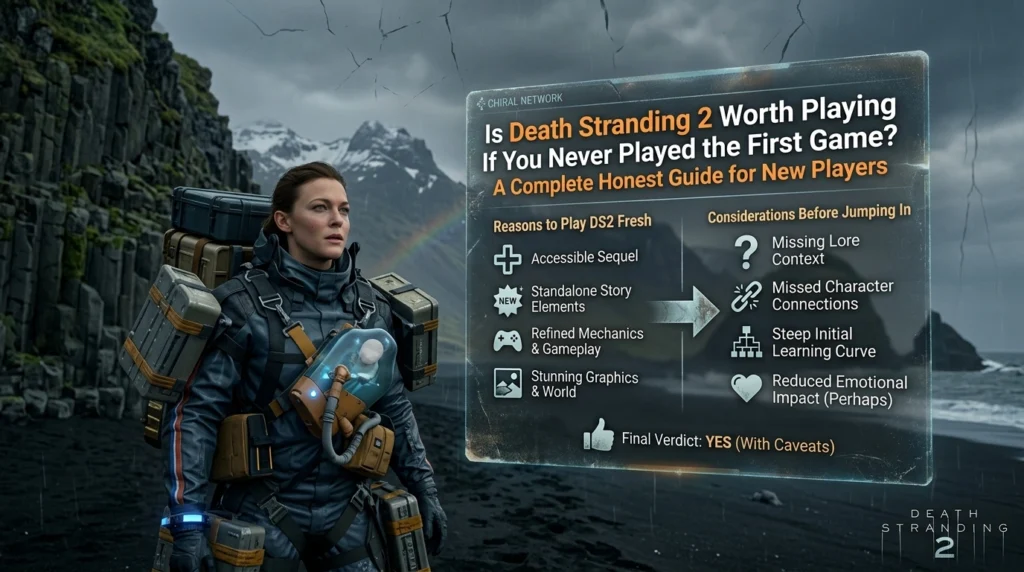
Yes — and Hideo Kojima designed it with this in mind. Death Stranding 2 is marketed and structured as a standalone sequel. New players can follow the story, understand the world, and engage with all gameplay systems without having played DS1.
However, “can play without DS1” and “gets the full experience without DS1” are different things. Death Stranding 2 contains numerous moments designed to land emotionally on players who experienced the first game. Certain character returns, story revelations, and tonal contrasts between what Sam was in DS1 and who he is in DS2 carry a weight that new players will not feel in the same way.
The honest recommendation: if you have time before DS2’s March 19 PC launch, play the Death Stranding Director’s Cut. It is available on PC via Steam and the Epic Games Store, and 15–25 hours of the core story is sufficient to understand everything DS2 builds on. If you do not have time or the patience for DS1’s slower opening pace — which famously takes 8–10 hours to fully reveal its gameplay systems — then DS2 as your entry point is entirely valid.
9. Why Death Stranding 2 Is Worth Your Time in 2026
- It is one of the most acclaimed games of 2025–2026 — a 10/10 from multiple outlets, Game of the Year consideration, and one of the highest user-rated games on PS5
- It fixed DS1’s main criticisms — Kojima directly addressed the pacing issues and combat sparseness that divided the original’s audience. DS2 is faster, more varied, and more immediately engaging
- It is visually extraordinary — the Decima Engine’s rendering of Australia’s landscapes represents some of the finest visual achievement in gaming today. On a high-end PC at 4K, it is genuinely breathtaking
- The story is emotionally ambitious in ways games rarely attempt — exploring themes of connection, legacy, and what it means to carry others through a broken world
- It is one of 2026’s few great story-driven single-player PC releases — March 2026 on PC is dominated by multiplayer and live-service titles. DS2 is a rare, substantial, cinematic single-player experience
- The PC version brings new modes and content — more reasons to engage than the original PS5 launch offered
10. Who Should Play Death Stranding 2?
- Players who love story-driven single-player games with deep world-building
- Fans of cinematic gaming experiences — Metal Gear Solid fans, The Last of Us fans, Horizon fans
- PC players looking for a technically ambitious, GPU-testing showcase with a real narrative
- Anyone curious about Hideo Kojima’s creative vision who has never experienced a Death Stranding game
- Players who found DS1 too slow — DS2 addresses this directly and is meaningfully faster-paced
- Players who enjoy exploration-based games where preparation and planning are as engaging as action
11. Who Should Skip or Wait?
- Players who exclusively enjoy fast-paced action games with constant combat — DS2 has more combat than DS1 but remains a slow, considered experience at its core
- Players who genuinely found DS1 unplayable — if the fundamental loop of traversal planning and cargo delivery held no appeal in the original, DS2 evolves but does not abandon that identity
- Players with limited time who want to start from DS1 — if you want to experience both games, waiting until you can play DS1 first will provide the fullest experience of DS2’s story payoffs
FAQs — New Players, Death Stranding 2
Q: Can you play Death Stranding 2 without playing Death Stranding 1?
Yes. Death Stranding 2 is designed as a standalone experience and marketed by Kojima Productions as such. New players can follow the story and enjoy all gameplay systems without prior knowledge. However, familiarity with DS1’s core concepts — the Death Stranding event, BTs, Timefall, Sam’s backstory — will make the narrative significantly more rewarding.
Q: Is Death Stranding 2 a “walking simulator”?
The “walking simulator” description was applied (often dismissively) to Death Stranding 1. Death Stranding 2 substantially expands the action, combat, vehicle systems, and moment-to-moment variety. While traversal and delivery remain central mechanics, DS2 is a fuller, more varied action-adventure experience than the original. Calling it a walking simulator in 2026 is no longer accurate.
Q: How long is Death Stranding 2?
The main story takes approximately 25–35 hours for most players. Full completion including all side content, community buildings, and exploration can extend this to 50+ hours. Hideo Kojima specifically designed DS2 to have fewer “drop-off points” than DS1 — the pacing is more consistent throughout.
Q: What genre is Death Stranding 2?
Kojima Productions created the term “strand game” specifically for Death Stranding — a new genre defined by connection, cooperation, and social gameplay. More conventionally, it can be described as a third-person open-world action-adventure with strong simulation elements, set in a science fiction post-apocalyptic world.
Q: Is Death Stranding 2 worth buying on PC if it is not on Game Pass?
Yes — for players interested in story-driven single-player experiences. Death Stranding 2 is not available on Xbox Game Pass. It is a premium purchase, but its 25–50 hour length, critical acclaim (multiple 10/10 reviews), and the new content arriving with the PC launch make it one of the stronger value propositions for its price point in early 2026.
Q: Is the Death Stranding 2 story hard to follow for new players?
DS2 is more accessible to newcomers than DS1 was. The new setting of Australia, the new organisation of DRAWBRIDGE, and several new characters provide natural entry points. The story does reference DS1 events and characters frequently, however — watching a DS1 story summary before playing will significantly improve comprehension and emotional engagement.
Q: What is the Social Strand System in Death Stranding 2?
The Social Strand System is Death Stranding’s signature asynchronous multiplayer feature. Physical objects you construct in the world — bridges, roads, safe houses, anchored ropes — can appear in other players’ games, and vice versa. You cannot see or directly interact with other players, but their constructions help you and yours help them. Liking another player’s structure sends them a notification. DS2 expands this with larger community projects where many players contribute to shared infrastructure.